
.png)
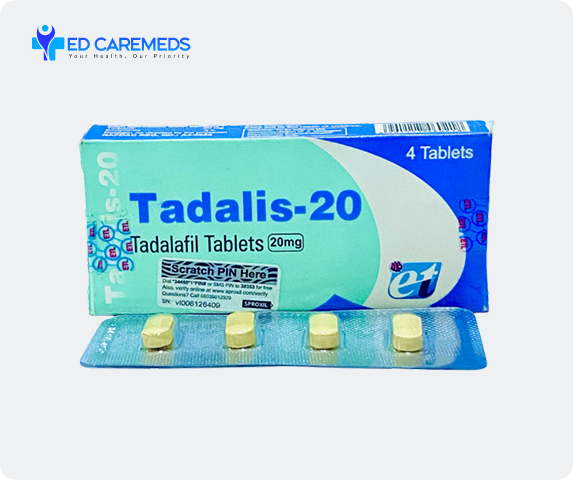
Tadalis 20 mg Tablet is a Cialis medicine contains Tadalafil used primarily to treat erectile dysfunction. It improves firm erection by supplying sufficient blood flow to the penis. Tadalafil 20 mg is the active FDA approved ingredient contains in Tadalis 20mg. Tadalis 20 mg is a PDE5 inhibitor relaxes smooth muscles and dilates blood vessels by maintaining cyclic GMP levels, help men improve penile blood flow in response to nitric oxide release during stimulation.
1.Erectile Dysfunction (ED)
Erectile dysfunction refers to the inability of a person to achieve or sustain an erection for a sufficient amount of time. For ED, Tadalis 20 mg improves blood flow to the penile tissue and relaxation of this tissue. For ED, the effects of Tadalis 20 mg must be consumed 30-60 minutes before the intended sexual activity.
2.Pulmonary Arterial Hypertension (PAH)
PAH consists of high blood pressure (over 20 mmHg) in the pulmonary artery, which is the artery responsible for transporting blood to the lungs from the heart. Tadalis 20 mg facilitates relaxation of the smooth muscle tissue in the pulmonary artery. As a result, there is sufficient blood flow and a reduction in blood pressure in the pulmonary artery.
3.Benign Prostatic Hyperplasia (BPH)
BPH is the non-cancerous enlargement of the prostate gland, which usually occurs due to old age. Due to this enlargement, the prostate gland presses down upon the uterus, which leads to lower urinary tract symptoms (LUTS). Tadalis 20 mg facilitates relaxation of smooth tissue in the prostate glands and also improves urinary function in BPH patients.
4.Other Uses of Tadalis 20 mg:
1) Erectile dysfunction (as needed use)
2) Erectile dysfunction (once-daily use)
3) Benign prostatic hyperplasia (BPH)
4) Erectile dysfunction with BPH
5) Pulmonary arterial hypertension (PAH)
Tadalis 20 mg contains the active ingredient Tadalafil, which is a PDE-5 inhibitor drug that targets the NO-cGMP pathway, which is involved in the circulation of blood in different tissues and organs.
Under normal conditions, the NO-cGMP pathway is activated in response to an external trigger (sexual stimulation, nervous system signalling, etc.). In response to these stimuli, the nerve endings or endothelial tissues release nitric oxide (NO), which rapidly diffuses in the surrounding tissues. It activates an enzyme called guanylate cyclase, which is responsible for converting guanosine triphosphate (GTP) into guanosine monophosphate (cGMP) molecules.
The cGMP molecules act as secondary chemical messengers to regulate further physiological responses in the area. The cGMP molecules reduce the intracellular calcium levels and facilitate the movement of potassium molecules into the cells. This facilitates the dilation of blood vessels (vasodilation). As a result, the blood flow in these blood vessels is increased. It also leads to the relaxation of smooth muscle tissues in the region.
These reactions are essential for normal functions in the physiological responses to external stimuli. These reactions are responsible for the formation of an erection, the working of arteries and veins, and other metabolic functions.
After a sufficient amount of cGMP molecules is accumulated, an enzyme called phosphodiesterase type-5 (PDE-5) is activated. This enzyme is constitutively present in the tissues where the NO-cGMP pathway is functional. It is released in response to a high concentration of cGMPs through a feedback mechanism.
The PDE-5 breaks down the cGMP molecules, thus reversing any physiological effects due to these molecules. This leads to the constriction of blood vessels and smooth muscle toning. These reactions are essential to bring the body back to its normal resting state. In the absence of the PDE-5 enzyme, the effects, such as vasodilation and relaxed tissues, would persist indefinitely. These can result in abnormal conditions such as prolonged erection or excessive dilation of the pulmonary artery.
However, in some individuals, the PDE-5 effects can be premature or excessive in some individuals. This prevents the cGMP molecules from carrying out their functions to a sufficient extent. This abnormality can lead to conditions like erectile dysfunction and pulmonary arterial hypertension.
Tadalis 20 mg selectively targets the PDE-5 enzymes and allows for the accumulation of a sufficient concentration of cGMP molecules in the tissue. As a result, there is sufficient blood flow in the blood vessels and enough relaxation of the smooth muscle tissues. Hence, Tadalis 20 mg is an effective medication for the treatment of those disorders that manifest due to impaired function of the PDE-5 enzyme.
1. Very Common & Common Side Effects
2. Less Common Side Effects
3. Rare but Serious Side Effects
4. Genitourinary Effects
5. Neurological Effects
6. Respiratory Effects
1.Does Tadalis 20 mg work without sexual stimulation?
No. Tadalis 20 mg works by enhancing the body’s natural physiological reactions. However, it cannot spontaneously procure an erection in the absence of sexual stimulation.
2.How long does Tadalis 20 mg stay in the body?
Tadalis 20 mg consists of Tadalfil, which has a longer half-life compared to other PDE-5 inhibitors (17.5 hours). It’s effectscan last for up to 36 hours, while metabolically, it can remain for up to 4 days.
3.Can diabetic patients use Tadalis 20 mg?
Yes. Diabetic patients can consume Tadalis 20 mg (only if prescribed by a doctor). However, there must be regular monitoring of blood sugar in such patients.
4.Why does Tadalis 20 mg sometimes cause muscle or back pain?
The active ingredient of Tadalis 20 mg, Tadalafil, can bind weakly to another enzyme, PDE-11, which is present in skeletal muscles of the back. This can lead to muscle pain in the back.
5.Can I consume Tadalis 20 mg on an empty stomach?
There is no effect of food consumption on the effectiveness of Tadalis 20 mg. However, heavy or fat-rich meals can delay its onset.
Be the first to share your experience with this product!