
.png)
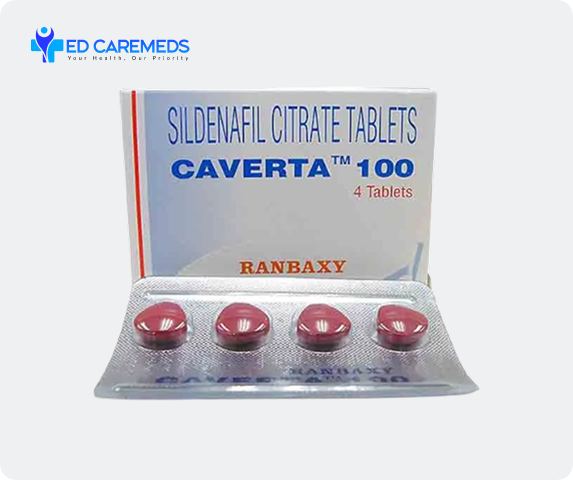
Caverta 100 mg is a prescription medicine, consisting of 100 mg of sildenafil citrate. It is primarily used in the treatment of erectile dysfunction. However, there are several off-label indications for sildenafil citrate such as pulmonary arterial hypertension, and altitude-induced hypoxemia. The primary cause of these indications is prevention of vasodilation, leading to constricted blood vessels. Caverta 100 mg works by promoting adequate blood flow in the affected regions, thus restoring its normal working.
Erectile Dysfunction (ED)
ED is the main, on-label indication for which Caverta 100 mg is prescribed. In ED, Caverta 100 mg works by promoting vasodilation (increased diameter of blood vessels), improved blood flow, and sustained erection for a sufficient amount of time. It must be noted that for ED, Caverta 100 mg is recommended on an on-demand basis.
Pulmonary Arterial Hypertension (PAH)
PAH refers to the excessive pressure in the pulmonary artery that can be caused by physiological, genetic, and lifestyle reasons. Sildenafil is used for the treatment of this disorder as it has a vasodilatory effect on the pulmonary artery, restoring the blood flow to an optimum level. However, PAH is an off-label indication for Caverta 100 mg, and it must only be consumed if prescribed by the doctor.
Raynaud’s Phenomenon
Raynaud’s phenomenon refers to the sudden narrowing of the arteries in the extremities, known as vasospasm. Sildenafil is used as an off-label treatment for Raynaud’s phenomenon. It maintains sufficient blood flow to these regions and reduces the frequency of vasospastic attacks.
Other Indications:
Pulmonary hypertension secondary to congenital heart disease
Sickle cell disease–related pulmonary hypertension (specialist use)
1.Erectile Dysfunction (On-label)
Recommended Dose:
Maximum Dose:
Important Clinical Information:
2.Erectile Dysfunction in the Elderly (over 65 years) / Hepatic or Renal Impairment
Recommended Dose:
Maximum Dose:
Important Clinical Information:
3.Pulmonary Arterial Hypertension (Off-label use)
Recommended Dose:
Maximum Dose:
Important Clinical Information:
4.Indication: Raynaud’s Phenomenon (Off-label)
Recommended Dose:
Maximum Dose:
Important Clinical Information:
5.High-Altitude Pulmonary Edema (Off-label)
Recommended Dose:
Maximum Dose:
Important Clinical Information:
6.Digital Ulcers associated with Systemic Sclerosis (Off-label)
Recommended Dose:
Maximum Dose:
Important Clinical Information:
7.Indication: Benign Prostatic Hyperplasia–Related LUTS (Adjunct, Off-label)
Recommended Dose:
Maximum Dose:
Important Clinical Information:
The active component present in Caverta 100 mg is 100 mg of sildenafil citrate. It targets the nitric oxide (NO)-cGMP pathway involved in the functioning of blood vessels in various anatomical systems. This pathway facilitates vascular smooth muscle relaxation, which promotes blood-vessel dilation.
Normally, the NO-cGMP pathway is activated in response to a certain signal (sexual stimulation, shear stress, endothelial signalling, etc.). Upon receiving such stimuli, NO is released either from the nerve endings or the endothelial cells. NO activates the enzyme guanylate cyclase, which converts GTP molecules to cyclic guanosine monophosphate (cGMP). cGMP molecules play a central role in the pathophysiology of several disease conditions, and their concentration must be optimum to prevent such conditions.
cGMP causes decrease in the intracellular calcium levels, which leads to the relaxation of vascular smooth muscles. As a result, the blood vessels dilate, and the blood flow in the region is increased.
To return the blood vessels back to its normal state, there is an enzyme known as phosphodiesterase type-5 (PDE-5), which is inherently present in the cells having the NO-cGMP pathway. It breaks down cGMP molecules and eventually fades their effects on the blood vessels. As a result, the blood vessels in the region go back to their normal size, and the blood flow is also reduced, compared to the enhanced flow observed after the cGMP effect.
It acts as a control switch in response to excess cGMP accumulation in the tissues. If cGMPs were allowed to persist indefinitely, then, the blood vessels would remain constantly dilated, the blood pressure would drop to an excessive extent, and vascular tone would be uncontrolled.
However, in certain conditions, the effects of the PDE-5 enzyme are either observed prematurely or they are overexpressed. As a result, the minimum dilation of blood vessels, and relaxation of the smooth muscle tissues is also not achieved. For e.g., in erectile dysfunction, the overexpression of PDE-5 prevents sufficient blood flow to the penis and affects the normal working of the corpus cavernosum (penile erectile tissue).
The sildenafil citrate present in Caverta 100 mg targets the PDE-5 enzyme, thus preventing the breakdown of cGMP molecules. It promotes adequate vasodilation, mediated by the NO-cGMP pathways, thus allowing sufficient blood flow to the tissues.
1.Very Common / Common
2.Eye / Vision-Related
3.Ear / Hearing-Related
4.Cardiovascular
5.Nervous System
6.Gastrointestinal
7.Respiratory / ENT
8.Genitourinary / Sexual
9.Skin / Allergic
10.Other / General
1.How long does Caverta 100 mg take to work? How long does its effects last?
Caverta 100 mg usually takes 30-60 minutes to start working. Its effects usually last for 4-6 hours after consumption.
2.Does Caverta 100 mg cause an automatic erection?
No. Caverta 100 mg cannot spontaneously induce an erection. It requires sexual stimulation to work.
3.Can Caverta 100 mg be taken with food?
Yes. However, heavy or fat-rich meals can delay the on-set of the working of Caverta 100 mg.
4.Can Caverta 100 mg be taken with other medications?
Individuals must inform their healthcare provider about any existing medication before consuming Caverta 100 mg.
5.Does Caverta 100 mg cause addiction?
Caverta 100 mg does not affect the reward system of the brain in any manner. Hence, there are no reports of addiction caused due to Caverta 100 mg.
Be the first to share your experience with this product!